
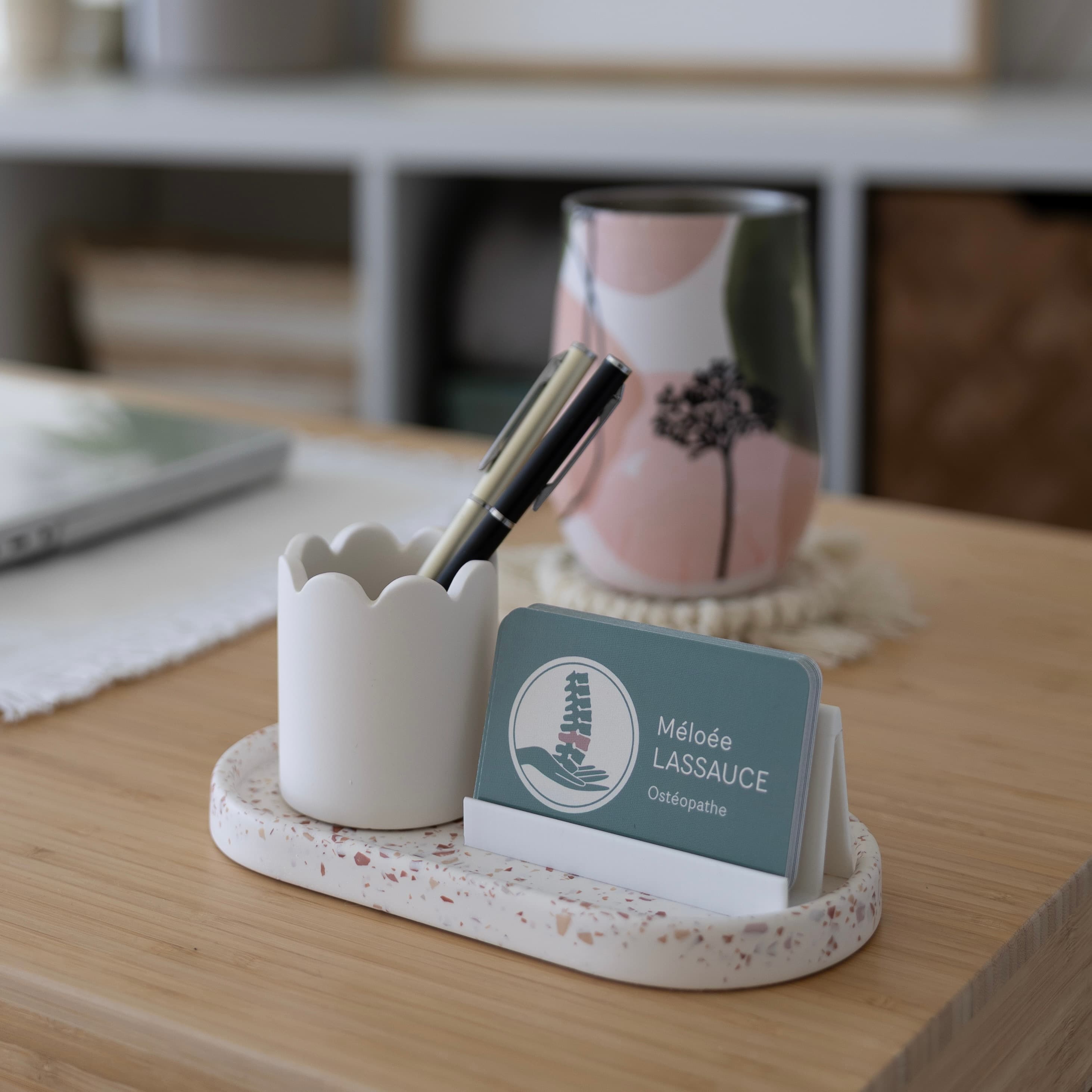
We don't always notice it, but the moment we step through a practice door, something activates. The body evaluates, before anyone has asked it the first question. Do I feel safe here? Can I relax? Do I want to come back?
One might think these are just impressions. Yet they are at the heart of a serious field of research: that of healing environments · the study of how a care setting directly influences the patient's state.
A 2015 study places healing spaces as one of eight fundamental components of optimal care, on a par with the therapeutic relationship or the practitioner's intention. Attending to the environment of a practice is to serve the care itself.
When I set up my practice in Luxembourg City, I thought through every detail so that you would feel comfortable there, and so that care would begin before we even exchange our first words.
When colour takes care of you
A clear, uncluttered space
Neutral colours, such as whites and greys, offer a balanced environment. But used in excess, they can be perceived as unwelcoming. In a care setting, an overly neutral environment risks maintaining · or even amplifying · the patient's apprehension.
The choice of colours
The practice is built around three main tones: green, pink and beige, complemented by wooden elements.
A systematic review published in 2024 synthesises several decades of studies and concludes that cool, desaturated colours (greens, blues) promote calm and relaxation, while warm tones such as beige and pink are associated with a feeling of comfort and welcome. Patients placed in environments with soothing colours reported lower levels of anxiety and greater satisfaction with their care.
A Korean study published in 2016 confirms that users of healthcare spaces spontaneously associate green with notions of health and stress relief, and that the most valued representations in a care context are those evoking the natural and the clear.
Plants
This association between green and the natural finds scientific support beyond colour alone. Studies show that the presence of plants in a care setting significantly reduces patients' anxiety and their perception of pain. The effect works through what researchers call biophilic theory: our instinctive need for proximity to the living world.
Natural light
Natural light is one of the most documented environmental factors in the care design literature. A large review covering several hundred studies identifies it as a consistent factor in reducing patient stress and anxiety. Patients in spaces that are bright, calm and offering a sense of privacy report higher satisfaction, both with their environment and with their care in general.
Concretely, natural light makes the space feel more alive, less confined, and allows the patient not to feel trapped in a medical bubble.
"The variety of form and brilliance of colour in the objects presented to patients are actual means of recovery."
- Florence Nightingale, Notes on Nursing, 1860
Florence Nightingale understood it all in 1860
What is remarkable in all this scientific literature is that it does nothing more than confirm what a British nurse formulated more than 160 years ago. In her Notes on Nursing published in 1860, Florence Nightingale recommended the presence of flowers, works of art and varied colours not as ornamentation, but as full components of care in their own right · and specified that this effect is physical, not merely psychological. Modern studies on the parasympathetic nervous system and the reduction of stress markers have since confirmed this.
Many studies cite her work as the starting point for all contemporary research on therapeutic design.
It is in this spirit that the watercolour depicting magnolias behind my desk has its full place.
References
- Sakallaris B.R. et al. (2015). Optimal Healing Environments. Global Advances in Health and Medicine, 4(3), 40·45.
- Tabanejad Z. (2024). The Impact of Color in Healthcare Environments: A Systematic Review. Shiraz E-Medical Journal, 25(12).
- Park H., Choi I. (2016). A Study on Tendency of Color Consciousness and Preference for Healthcare Environmental Color. Journal of the Korean Institute of Interior Design, 25(2), 83·91.
- Jamshidi S., Parker J.S., Hashemi S. The effects of environmental factors on patient outcomes in hospital environments: A review of literature.
- Ulrich R.S. et al. (2008). A Review of the Research Literature on Evidence-Based Healthcare Design. HERD, 1(3), 61·125.
- Harris P.B. et al. (2002). A Place to Heal: Environmental Sources of Satisfaction Among Hospital Patients. Journal of Applied Social Psychology, 32.
- Nightingale F. (1860). Notes on Nursing. Harrison and Sons.